Public vs International Hospitals in China: A Guide for Foreign Patients
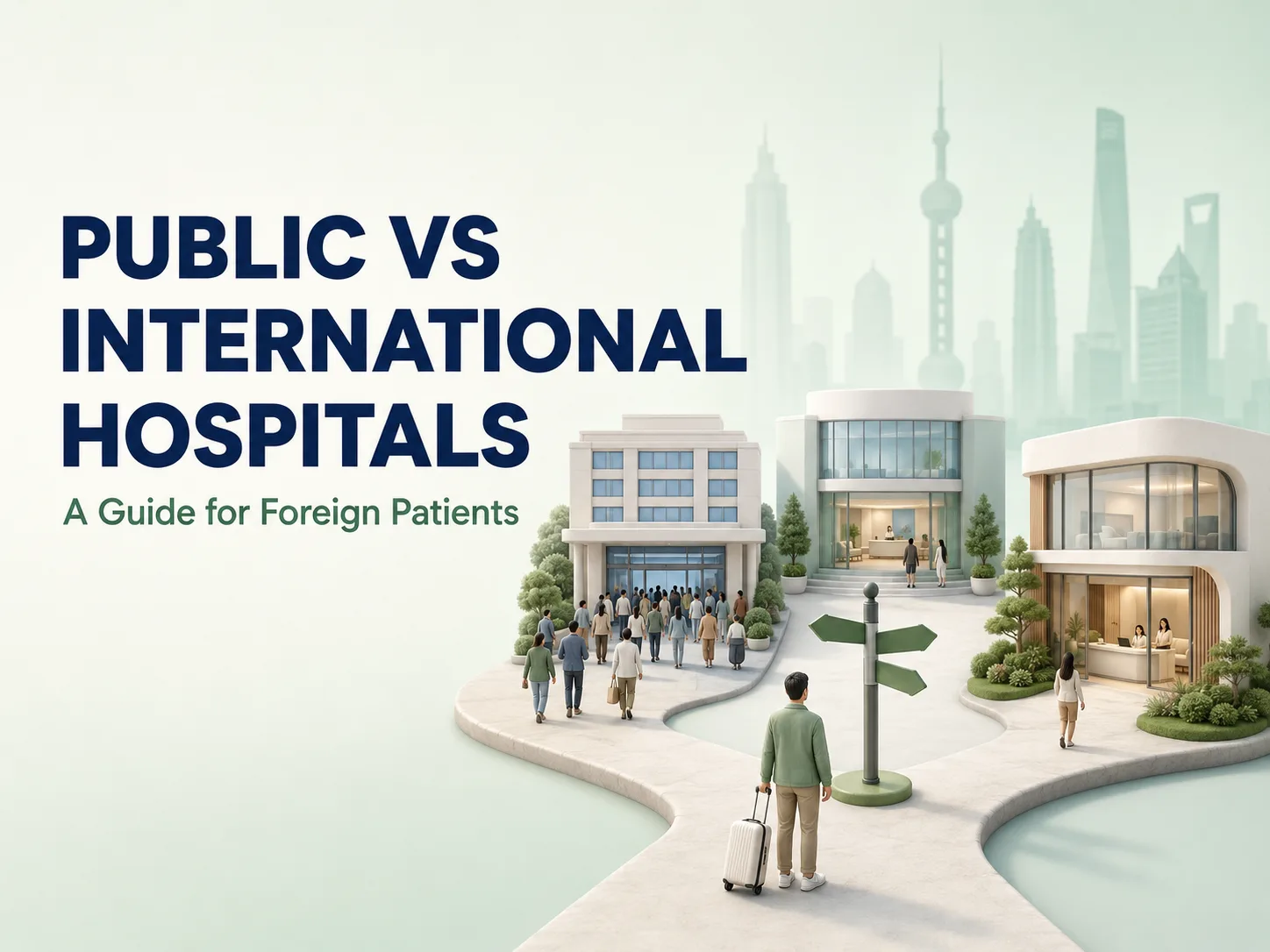
You’ve decided to seek medical treatment in China, but now you’re looking at three very different options:
- a general department in a public hospital;
- an international or VIP department inside a public hospital;
- a private international hospital.
They may all be located in the same city, and some may even have doctors from similar clinical backgrounds. But the appointment process, language support, cost and insurance arrangements can be very different.
The right choice depends on your condition and the support you need—not simply which hospital is the cheapest or most expensive.
Medical information notice: This article compares ways of accessing healthcare in China. It does not recommend a hospital for a particular diagnosis and does not replace advice from a qualified medical professional.
01 The Three Main Options
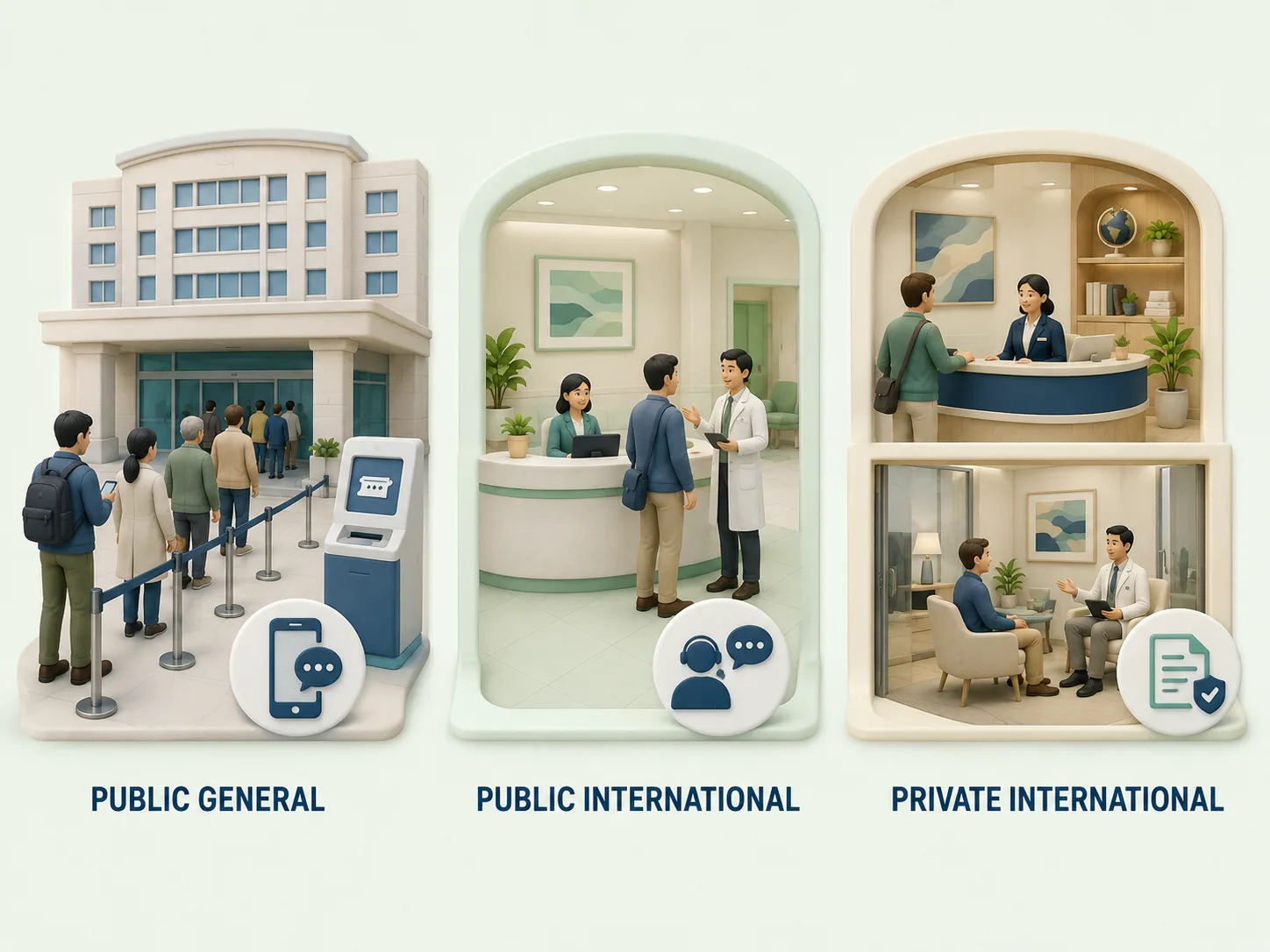
| Hospital option | Costs | Language support | Appointment experience | Often suitable for |
|---|---|---|---|---|
| Public hospital general department | Usually the lowest of the three | Varies; may be limited | Can require local systems or on-site help | Patients who prioritize specialist access and can manage the local process |
| Public hospital international or VIP department | Higher than the general department | More likely to offer English or coordination | Usually more structured | Patients wanting public-hospital expertise with more assistance |
| Private international hospital | Usually the highest | English and international patient support are commonly available | Often easiest to arrange remotely | Patients prioritizing language, coordination, comfort and insurance support |
These are general patterns, not nationwide rules. Always check the specific hospital, campus, department and doctor.
02 Public Hospital General Departments
China’s major public hospitals often contain many specialized departments and handle large numbers of patients.
For an international patient, the main advantage may be access to a particular clinical department or treatment capability. However, the general outpatient system is designed mainly for domestic patients.
You may need to manage:
- Chinese-language hospital websites;
- WeChat appointment services;
- registration using passport information;
- finding the correct building and department;
- several separate payment steps;
- limited English at some service counters;
- returning to the doctor after tests.
Foreign patients can still use public hospital general departments. Shanghai’s official foreign-patient guide describes registering with a passport and receiving a hospital card for later visits. Shanghai Local Hospital Guide
Public general care may suit you if:
- the hospital has a department specifically relevant to your condition;
- you have confirmed the appointment in advance;
- you have a reliable medical interpreter;
- you can manage a busy hospital environment;
- you’re comfortable handling payments and tests yourself;
- the hospital has confirmed that it accepts your case.
It may not suit you if:
- you need continuous English-language support;
- you have limited mobility;
- your condition requires extensive coordination;
- you’re travelling alone;
- you expect your international insurer to settle the bill directly;
- you need help arranging accommodation, follow-up and transport.
Don’t assume every doctor in a major city speaks English. Some may communicate well in English, while others may not use it during routine clinical work.
03 Public Hospital International and VIP Departments
Many well-known public hospitals operate an international medical department, international clinic or VIP service.
These departments may provide:
- a more structured appointment process;
- fewer administrative barriers for passport holders;
- patient coordination;
- English-language support;
- longer consultation times;
- access to specialists from the main public hospital;
- assistance arranging tests and follow-up;
- commercial insurance support in some cases.
Beijing’s government currently lists multiple public hospitals with international medical services, including international departments and VIP clinics. It also distinguishes institutions providing full-process foreign-language services. Beijing Medical Guide for Foreigners
However, the word International doesn’t guarantee that every doctor, nurse and cashier will speak fluent English.
Before booking, ask:
- Is English available throughout the visit or only at reception?
- Is interpretation included in the consultation fee?
- Will I see a specific specialist?
- Does the international department provide inpatient care?
- Are tests completed in the international department or the main hospital?
- Can it handle emergencies?
- Does it accept my insurance for direct billing?
A public international department may suit you if:
- you want access to a major public hospital;
- you need help navigating the process;
- you prefer a quieter or more structured environment;
- you want a specific specialist who also works in the international department;
- you need English communication confirmed in advance.
Fees are generally higher than the hospital’s ordinary outpatient department, but pricing varies substantially. Ask for the actual registration, consultation, testing and inpatient charges before travelling.
04 Private International Hospitals
Private international hospitals are usually designed around appointments, patient coordination and multilingual communication.
They may offer:
- English-speaking customer service;
- international patient coordinators;
- remote appointment arrangements;
- assistance transferring medical records;
- international insurance processing;
- private rooms;
- easier communication with family members;
- coordinated follow-up after discharge.
Some private international hospitals have direct-billing agreements with international insurers. For example, United Family Healthcare publishes facility-specific direct-billing information and advises patients to confirm their insurer and policy before treatment. United Family Healthcare Direct Billing
Jiahui in Shanghai similarly states that direct billing is available for insurance plans with which it has an agreement. Jiahui International Patient FAQ
Direct billing doesn’t mean everything is automatically covered. Your insurer may still require:
- pre-authorization;
- a deductible;
- a co-payment;
- confirmation that the treatment is medically necessary;
- limits on hospital rooms or medicines;
- additional approval for surgery or hospitalization.
A private international hospital may suit you if:
- you need English-language coordination from the beginning;
- you want to send your records before travelling;
- you require help organizing multiple departments;
- your insurer has a direct-billing agreement;
- you value privacy and convenience;
- you’re willing to pay more for non-clinical services.
But don’t choose a private hospital based only on comfort. Confirm that it has the department, equipment, inpatient support and emergency capability required for your condition.