How to Contact and Book a Chinese Hospital Before You Travel
You’ve selected a hospital in China and found the name of the department you need. But the hospital website is mainly in Chinese, the booking app asks for a Chinese ID number, and you’re not sure whether sending an email means you actually have an appointment.
This is a common problem for international patients.
To book a hospital in China before travelling, you need to contact the correct hospital department, submit a clear medical summary and receive written confirmation of what has—or hasn’t—been arranged.
An initial reply, medical record review or suggested doctor doesn’t automatically mean that your consultation, hospital admission or treatment has been confirmed.
Medical disclaimer: This article is for informational purposes only and does not constitute medical advice. Discuss your condition and fitness to travel with a qualified medical professional. In an emergency in China, call 120 or go to the nearest emergency department.
Choose the Correct Contact Channel
Start with the hospital’s official website or an official government hospital directory.
Look for pages labelled:
- International Medical Services
- International Medical Center
- International Department
- VIP Medical Services
- Overseas Patient Services
- Appointment
- Patient Services
- Contact Us
Depending on the hospital, you may be able to make contact through:
- an international patient hotline;
- an official hospital email address;
- an online enquiry form;
- the hospital’s official WeChat account;
- the hospital’s official app;
- a city appointment platform;
- an authorized international patient coordinator.
Beijing’s official medical guide says international users can access the English-language International Service Beijing service through WeChat or Alipay and use the Beijing 114 appointment platform.
Shanghai’s official guidance says many hospitals offer reservations through websites, WeChat and local platforms. These are city-level examples, not one nationwide booking system.
For cross-border treatment, contacting the hospital’s international department directly is usually more practical than trying multiple local apps that may require Chinese identification or a local phone number.
If you haven’t chosen a provider yet, use our guide on how to choose the right hospital in China for your medical treatment before contacting random departments.
Confirm That You Have the Real Hospital
Before submitting your passport or medical records, check:
- the official Chinese and English hospital names;
- the website domain;
- the international department’s telephone number;
- the email domain;
- the hospital campus;
- whether the contact details also appear on a government or hospital page.
A hospital may have several campuses, and each campus may offer different departments.
Save the hospital’s name and address in Chinese. English names can vary between websites, booking systems and map applications.
Don’t send passport scans or sensitive medical files to an unverified social-media account.
Prepare a Short Patient Summary First
Hospital staff shouldn’t have to search through 80 pages of records to understand why you’re contacting them.
Prepare a one-page summary containing:
- full name exactly as shown on your passport;
- date of birth;
- sex as recorded in your medical documents;
- nationality;
- current country and time zone;
- preferred language;
- main diagnosis or symptoms;
- date of diagnosis;
- treatment already received;
- current medications;
- allergies;
- important medical conditions;
- the treatment or specialist opinion you’re requesting;
- preferred travel period;
- whether a companion will travel with you;
- insurance information, if relevant.
Keep the summary factual. Don’t remove important diagnoses or medications because you think they’re unrelated.
The hospital needs enough information to decide which department should review the case.
Organize Your Medical Records
Create clearly named folders instead of sending random phone photographs.
A practical structure is:
01_Medical_Summary02_Doctor_Reports03_Lab_Results04_Imaging_Reports05_DICOM_Images06_Pathology07_Medication_List08_Passport_Copy09_Insurance
Use file names that include the document type and date:
MRI_Lumbar_Spine_2026-07-18.pdf
This is much clearer than:
IMG_4837.jpg
Whenever possible, include the original medical report rather than only your own translation.
For imaging, ask whether the hospital needs:
- the written radiology report;
- DICOM files;
- a download link;
- images on a physical disc;
- new imaging after arrival.
For pathology review, ask before sending slides, blocks or other physical materials. The hospital should tell you whether they’re required and how they must be delivered.
Translate the Most Important Documents
You don’t necessarily need to translate every page before the first enquiry.
Start with:
- the medical summary;
- confirmed diagnosis;
- recent specialist report;
- operation report;
- pathology report;
- major imaging conclusions;
- medication and allergy list.
Ask whether the hospital accepts English records. International departments are more likely to work with English documents, but requirements vary.
If Chinese translation is required, use a qualified medical translator for clinically important documents. Automatic translation may help hospital staff understand a simple enquiry, but it shouldn’t be trusted for dosages, pathology findings, consent forms or surgical risks.
Keep both the original document and translation together.
Send a Clear First Enquiry
Your first message should be short enough to read quickly but detailed enough to direct correctly.
Subject: International Patient Enquiry – [Diagnosis] – [Full Name]
Dear International Medical Services Team,
My name is [full name], and I’m a citizen of [country]. I’m considering travelling to China for medical treatment.
I was diagnosed with [diagnosis] in [month and year]. I have received [previous treatment], and I’m currently taking [main medications].
I would like to request [a specialist consultation / a second opinion / an assessment for a specific treatment].
Could you please confirm:
- whether your hospital accepts international patients with this condition;
- which department should review my case;
- what medical records you require;
- whether a remote record review is available;
- how I can book using my passport;
- whether English-language coordination or interpretation is available;
- the estimated consultation fee and payment method;
- the earliest available appointment period.
My preferred travel dates are [dates], but I can adjust them if necessary.
I have attached a short medical summary and recent reports. Please let me know if you require additional documents.
Kind regards,
[Full name]
[Country]
[Telephone/WhatsApp/WeChat]
[Email]
[Time zone]
Don’t attach extremely large files to the first email. Ask whether the hospital provides a secure upload portal or accepts a cloud-storage link.
What the Hospital May Do Next
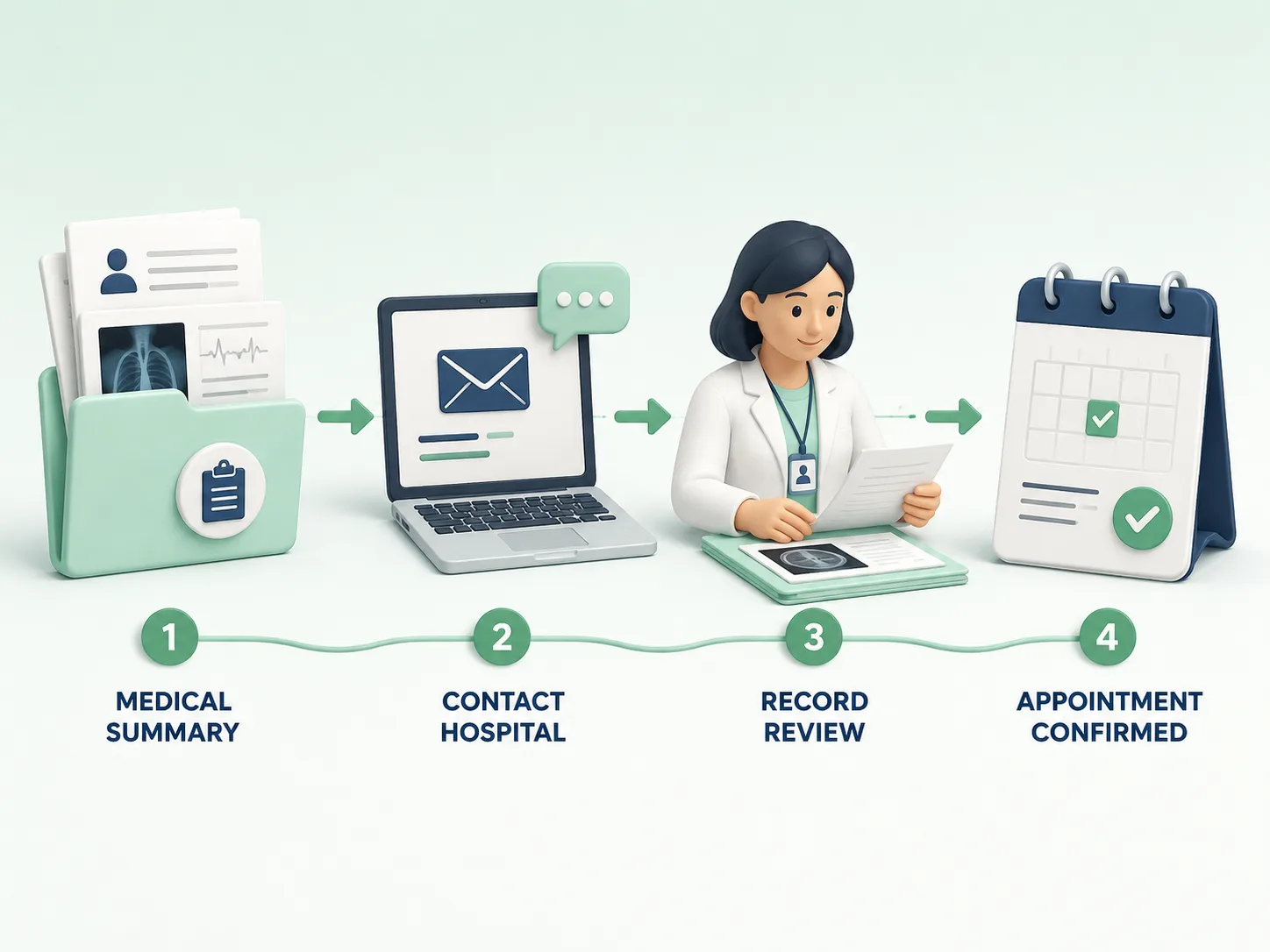
After receiving your enquiry, the hospital may:
- ask for additional reports;
- recommend another department;
- arrange a preliminary record review;
- offer a remote consultation;
- request an appointment deposit;
- provide an available doctor or date;
- explain that an in-person assessment is required;
- decline the case;
- refer you to another hospital.
A request for more information isn’t a rejection. It may mean the clinical team can’t assess the case safely from the documents provided.
Likewise, a positive initial review isn’t a guarantee that the hospital will perform the requested treatment.
The final decision may depend on physical examination, updated tests, bed availability and the treating team’s assessment.
Booking Without a Chinese ID Number
Many hospital systems use real-name registration.
For a short-term foreign patient, your original passport is normally the most practical identification document. Peking Union Medical College Hospital’s official patient notice, for example, lists a valid passport among the accepted documents for first-time patient registration.
However, an online form may only display fields designed for a Chinese ID number.
If this happens:
- Don’t enter a false ID number.
- Take a screenshot of the problem.
- Contact the international department or appointment hotline.
- Ask for manual passport registration.
- Confirm whether you need to create a patient number after arriving.
- Ask whether the appointment can be held under your passport name.
Use your name exactly as it appears in your passport. Don’t switch the surname and given name between messages unless the hospital instructs you to follow a specific format.
Chinese Message for Passport Registration
我是外国患者,没有中国身份证。我可以使用护照预约和建档吗?
Wǒ shì wàiguó huànzhě, méiyǒu Zhōngguó shēnfènzhèng. Wǒ kěyǐ shǐyòng hùzhào yùyuē hé jiàndàng ma?
I’m an international patient and don’t have a Chinese ID card. Can I use my passport to make an appointment and create a patient record?
You can send this to the hospital’s official service account or show it at the registration desk.
An Enquiry Is Not an Appointment
Before booking flights, ask for written confirmation showing:
- patient’s full name;
- passport number or patient number, if used;
- hospital name;
- hospital campus;
- department;
- doctor or medical team;
- appointment date;
- appointment time or arrival window;
- appointment type;
- registration or consultation fee;
- deposit already paid;
- remaining payment instructions;
- check-in location;
- contact person or service desk;
- documents to bring;
- fasting or medication instructions, if any.
If the hospital only says, “You can come next month,” you don’t yet have enough information.
Ask:
Could you please send written appointment confirmation with the date, department, campus and check-in instructions?
Consultation, Admission and Treatment Are Different
Your first confirmed booking may only be an outpatient consultation.
It doesn’t necessarily reserve:
- a hospital bed;
- an operation date;
- a treatment course;
- rehabilitation;
- a specific doctor for the procedure.
Ask the hospital to identify exactly what has been booked.
A common sequence is:
- Medical records submitted
- Department selected
- Outpatient consultation booked
- Patient arrives in China
- Doctor examines the patient
- Additional tests completed
- Treatment plan confirmed
- Deposit paid
- Admission or procedure scheduled
Your travel plan should leave room for assessment and schedule changes.
Ask About Costs and Payment Before Sending Money
Request written information about:
- consultation fee;
- remote review fee;
- international service fee;
- interpreter fee;
- appointment deposit;
- estimated test costs;
- estimated treatment range;
- inpatient deposit;
- accepted payment methods;
- cancellation and refund rules;
- insurance documents.
A treatment estimate may change after your doctor reviews new tests.
If using insurance, send the hospital:
- insurer’s name;
- policy number;
- insurance card;
- authorization contact;
- direct-billing request.
Direct billing only works when your insurer and the medical institution have an applicable arrangement. Otherwise, you may need to pay the hospital and claim reimbursement later.
Pay through a verified hospital account or official payment channel. If the receiving account name doesn’t match the hospital or its authorized service provider, stop and verify it.
Confirm Language and Companion Arrangements
Ask whether the hospital provides:
- an English-speaking coordinator;
- medical interpretation;
- translated consent support;
- English medical summaries;
- assistance with admission and discharge;
- communication with your insurer.
If you’re travelling with a companion, ask whether that person may:
- enter the consultation room;
- stay during admission;
- sign any documents;
- receive updates;
- stay overnight;
- collect reports or medication.
Rules can vary by hospital and ward.
Provide the hospital with your companion’s full name and contact details if requested.
Don’t Book Non-Refundable Travel Too Early
You can start comparing flights while the hospital reviews your case, but wait for a confirmed appointment before locking in a rigid schedule.
Even after confirmation, choose flexible tickets where practical.
Doctor schedules, inpatient beds and treatment dates can change. Allow extra days before and after the expected treatment period.
Don’t build a sightseeing itinerary around an estimated discharge date.
Treatment comes first, recovery comes second, and tourism should only begin after your doctor confirms that it’s medically appropriate.
Reconfirm Before Flying
Contact the hospital again several days before departure.
Confirm:
- the appointment is still active;
- the doctor and department haven’t changed;
- the correct campus address;
- arrival time;
- whether you should eat or fast;
- whether any medication should be adjusted;
- original documents required;
- deposit balance;
- airport-to-hospital contact;
- what to do if your flight is delayed.
Never stop medication or fast unless the treating team gives you clear instructions.
Save all essential information offline, including:
- appointment confirmation;
- hospital name in Chinese;
- Chinese address;
- hospital phone number;
- coordinator’s contact;
- passport copy;
- insurance details;
- medication list;
- emergency contact.
What to Bring to the First Appointment
Carry:
- original passport;
- printed appointment confirmation;
- patient number or hospital card, if issued;
- original medical documents;
- translated key reports;
- imaging files;
- current medication list;
- allergy list;
- insurance card and authorization;
- accepted payment method;
- hospital address in Chinese;
- interpreter or companion contact.
Arrive earlier than the consultation time. First-time passport registration, payment and finding the correct building may take additional time.
If the Hospital Doesn’t Reply
Wait a reasonable number of working days, allowing for Chinese public holidays and the time-zone difference.
Then:
- Send one short follow-up email.
- Call the official international patient number.
- Try the hospital’s official WeChat account.
- Confirm that you contacted the correct campus.
- Ask whether there is another international patient channel.
- Contact your second-choice hospital.
Don’t send the same large attachment repeatedly.
If your condition is worsening or urgent, don’t wait for an overseas appointment. Seek local medical care immediately.
FAQ
Can I book a Chinese hospital from overseas?
International departments may accept enquiries by telephone, email, online form or official messaging account. Some local booking platforms may require additional registration.
Can I book using a foreign passport?
Contact the hospital for manual passport registration if the app only accepts Chinese identification.
Should I send my full medical history immediately?
Ask the hospital how it wants to receive large imaging files, pathology materials or extensive records.
Does a confirmed consultation mean my treatment is approved?
The hospital may need to examine you and perform additional tests before confirming treatment, admission or surgery.
Can I book a specific Chinese specialist?
Confirm whether the appointment is with the named doctor or with the department’s medical team.
Should I pay a deposit before travelling?
Do Chinese hospitals provide English appointment services?
English support isn’t universal, so confirm it directly before travelling.