Do I Need a Visa for China? Visa & Visa-Free Guide | Gochinio

Planning a trip to China and wondering whether you need a China visa?
You may not need one.
Depending on your nationality, passport type, purpose of travel, length of stay, and itinerary, you may qualify for visa-free entry to China, 240-hour visa-free transit, or another visa exemption.
If none of these applies to you, you will normally need to apply for the appropriate Chinese visa before traveling.
This guide explains the main options so you can quickly work out what you need before your trip.
Quick answer:
Before applying for a China visa, check whether your passport qualifies for visa-free entry or whether your itinerary qualifies for China's 240-hour visa-free transit policy.
Do You Need a Visa to Visit China?
It depends.
For most travelers, there are four main possibilities:
| Your situation | What may apply |
|---|---|
| Your nationality qualifies for China's visa-free policy | You may enter China without a visa for an eligible short-term visit |
| China has a mutual visa exemption agreement covering your passport | You may qualify for visa-free entry under that agreement |
| You are traveling through China to a third country or region | You may qualify for 240-hour or 24-hour visa-free transit |
| None of the visa exemptions applies | You will normally need an appropriate Chinese visa |
The important thing is to check the rules for your passport and your specific trip.
Someone traveling on a French passport, for example, may have different requirements from someone traveling on a U.S. passport. A tourist may also have different requirements from someone coming to work or study.
1. Who Can Visit China Without a Visa?
China currently allows ordinary passport holders from a number of countries to enter without a visa for certain short-term visits.
Under China's current unilateral visa-free policy, eligible travelers may visit China for up to 30 days for purposes including:
- Tourism
- Business
- Visiting family or friends
- Exchange visits
- Transit
China also has mutual visa exemption agreements with a number of countries.
These are separate from the unilateral visa-free policy and may have different conditions.
Because the list of eligible countries and the validity periods of individual policies can change, Gochinio does not recommend relying on an old country list copied from another website.
Always check the latest rule for your passport before traveling.
Gochinio Tip: If your trip is coming up soon, check the official visa-free policy before you start a visa application. You may discover that you don't need a visa at all.
2. What Is China's 240-Hour Visa-Free Transit?
If your nationality does not qualify for ordinary visa-free entry—or your trip is specifically a transit journey—you may still qualify for China's 240-hour visa-free transit policy.
Eligible travelers can stay in permitted areas of China for up to:
240 hours — 10 days
without obtaining a Chinese visa in advance.
But there is one very important condition:
You must be traveling to a third country or region.
Think of the journey as:
Country/Region A → China → Country/Region B
For example:
United States → Shanghai → Japan
This may qualify if you meet the other requirements.
But:
United States → Shanghai → United States
would not normally satisfy the third-country/region transit requirement.
You must also:
- Hold an eligible passport
- Have valid international travel documents
- Have a confirmed onward ticket to a third country or region
- Enter through an eligible port
- Stay within the areas permitted under the policy
- Leave China within the permitted period
The current 240-hour policy covers eligible nationals from dozens of countries and designated entry ports across multiple regions of China.
Can you travel around China during the 240 hours?
Not everywhere.
The policy allows travelers to move within specified permitted areas. The exact area depends on where you enter China.
So don't assume that 240-hour visa-free transit means you can automatically travel anywhere in the country for 10 days.
Check the permitted area for your entry port before planning your itinerary.
3. What About the 24-Hour Visa-Free Transit Policy?
China also has a 24-hour visa-free transit policy.
This is available under different conditions and is primarily designed for travelers transiting through China to another country or region.
If you remain within the restricted area of the port during your transit, different requirements may apply from those for travelers who want to leave the airport or port.
If you need to leave the restricted area, you may need to obtain a temporary entry permit from the immigration inspection authority.
For a longer stopover that includes sightseeing or staying overnight in China, check whether you qualify for the 240-hour policy instead.
4. What Type of China Visa Do You Need?
If you don't qualify for visa-free entry, you'll need to choose a visa that matches the actual purpose of your visit.
Here are some of the most common China visa types for foreign travelers:
L Visa — Tourism
The China tourist visa, or L visa, is for people traveling to China for tourism.
If you're planning a holiday in China and don't qualify for visa-free entry, this is likely the visa you'll need.
M Visa — Business
The M visa is for commercial and trade activities.
It may apply if you're coming to China for activities such as business meetings, trade-related visits, or other commercial purposes.
F Visa — Exchanges and Visits
The F visa is used for certain exchanges, visits, study tours, inspections, and other non-commercial activities.
Q1 / Q2 Visa — Family Visits
These visas apply to certain family members of Chinese citizens or foreigners with permanent residence in China.
The appropriate category depends partly on the nature and duration of the visit.
S1 / S2 Visa — Private Visits
These categories are commonly relevant to certain family members of foreigners working or studying in China and to some other private matters.
X1 / X2 Visa — Study
For foreign students coming to study in China.
Z Visa — Work
For foreigners coming to China for employment.
There are other Chinese visa categories as well.
If you're unsure, check the official description of each visa category before applying.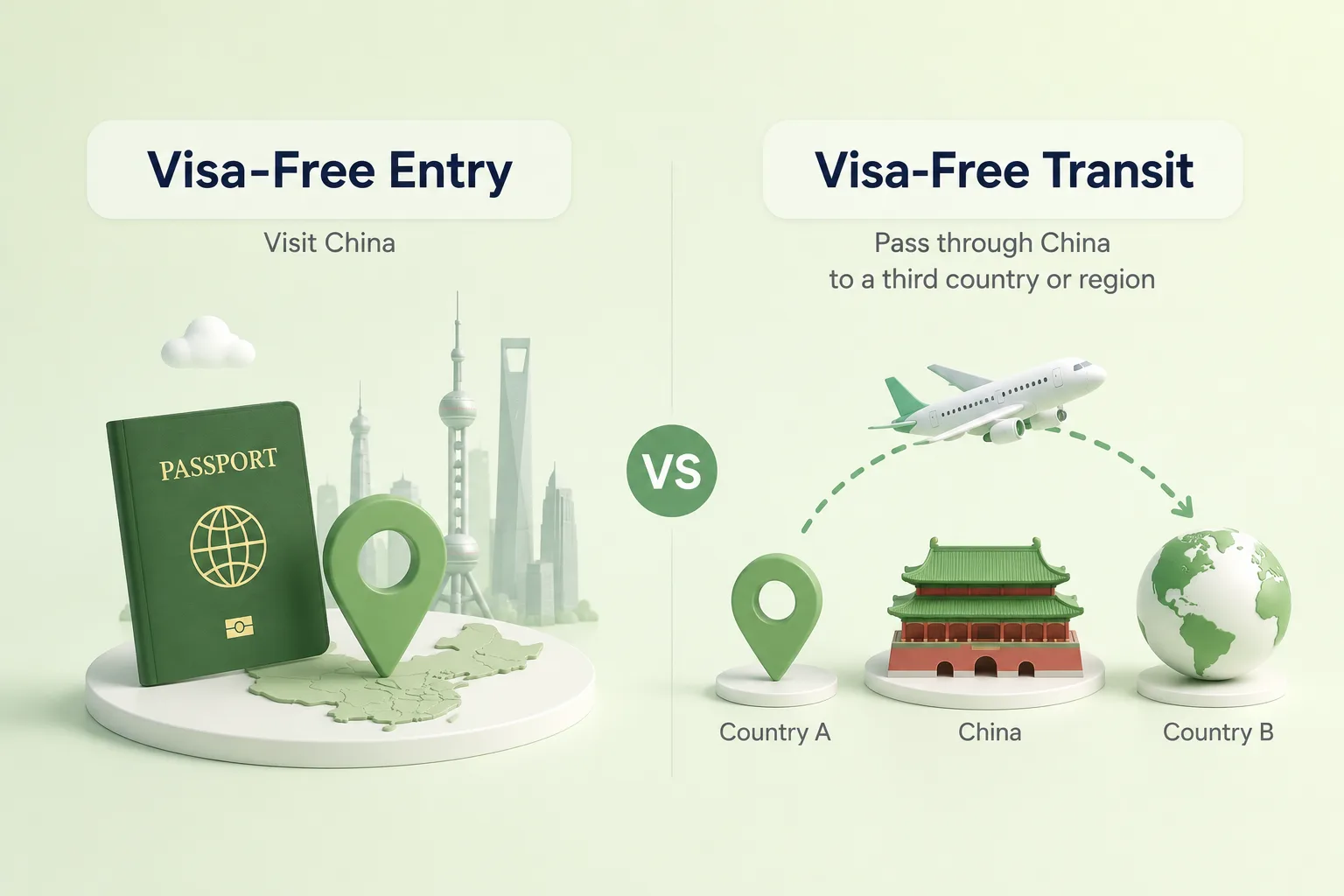
5. How to Apply for a China Tourist Visa
If you're visiting China for tourism, don't qualify for visa-free entry, and need a visa, you will normally apply for an L visa.
The exact China visa application process varies depending on the country or region where you apply.
A typical process looks like this:
Step 1: Check whether you actually need a visa
Do this before anything else.
Check whether your passport qualifies for visa-free entry or whether your itinerary qualifies for visa-free transit.
Step 2: Find the correct application location
Depending on where you live, applications may be handled by a Chinese embassy, consulate, or Chinese Visa Application Service Center.
Follow the instructions for the location responsible for your application.
Step 3: Complete the application
Enter your information carefully.
Your name, passport details, purpose of travel, and other information should match your supporting documents.
Step 4: Prepare the required documents
Requirements vary by visa type and application location.
Prepare everything listed by the authority handling your application.
Step 5: Submit your application
Follow the local procedure for submitting your passport, application, and supporting documents.
Step 6: Wait for processing
Processing times vary.
Apply with enough time before your planned departure and avoid assuming that someone else's processing time will be the same as yours.
6. What Documents May You Need for a China Visa?
The exact China visa requirements depend on your nationality, visa type, application location, and personal circumstances.
For a tourist visa, you may be asked for documents such as:
- Valid passport
- Completed visa application information
- Passport-style photograph
- Travel itinerary
- Flight or transportation information
- Hotel or accommodation information
- Previous Chinese visas or passports, where applicable
- Other supporting documents requested by the relevant authority
Business, work, study, and family-related visas can require different supporting documents.
Do not rely on a generic online checklist alone.
Use the document list provided by the Chinese embassy, consulate, or visa application center responsible for your application.
7. Coming to China for Business?
If you're traveling to China for a trade fair, exhibition, business meeting, commercial visit, or other short-term business activity, don't automatically assume you need an M visa.
First check whether your nationality qualifies for China's current visa-free entry policy.
Eligible travelers may enter visa-free for certain short-term business activities within the permitted stay period.
If the visa-free policy does not apply to you, an M visa may be appropriate for commercial and trade activities.
For work, employment, or activities requiring specific approval, different visa requirements apply.
8. What Should You Prepare Before Flying to China?
Getting the visa right is only part of preparing for your trip.
Before departure, keep the following information and documents ready:
- Passport
- Chinese visa, if required
- Return or onward ticket information
- Hotel or accommodation details
- Chinese address of your accommodation
- Invitation or business information, if relevant
- Documents supporting the purpose of your visit
- Copies or digital backups of important travel documents
It's especially useful to save your hotel name and address in Chinese on your phone.
After landing, you'll still need to go through China's arrival and border inspection procedures.
Read our Arriving in China: A Step-by-Step Entry Guide to see what happens from arrival card and border inspection to baggage claim and customs.
You may also want to arrange your SIM card and internet access in China before departure so you can use maps, translation, transportation, and other services as soon as you arrive.
9. Visa-Free Entry vs. Visa-Free Transit: What's the Difference?
These two policies are easy to confuse.
Visa-Free Entry
You enter China without a visa because your nationality and purpose of travel qualify under a visa exemption policy.
Your trip does not necessarily need to continue to a third country simply because you are using ordinary visa-free entry.
Visa-Free Transit
You are passing through China while traveling from one country or region to another.
The onward destination is an essential part of qualifying for the transit policy.
A simple way to remember it:
Visa-free entry = visiting China
Visa-free transit = passing through China on the way somewhere else
Always check the detailed requirements that apply to your situation.
Ready for Your Trip to China?
China has made travel easier for many international visitors through expanded visa-free policies and longer visa-free transit.
But entry requirements are not the same for everyone.
Before booking your trip, check three things:
Your passport → Your reason for visiting → Your itinerary
If you're eligible for visa-free entry, your trip may be much simpler than you expected.
If you need a visa, identify the correct visa type and follow the requirements of the Chinese embassy, consulate, or visa application center handling your application.
Once that's sorted, you can move on to the fun part:
Planning your trip and exploring China.
Official Sources & Information Note
This guide is based on information published by China's Ministry of Foreign Affairs, Chinese Consular Service, and National Immigration Administration.
As of August 2026, China's current unilateral visa-free policy covers eligible ordinary passport holders from 50 countries for stays of up to 30 days for specified purposes. China's 240-hour visa-free transit policy currently covers eligible nationals from 55 countries using designated ports and permitted stay areas.
Visa policies can change, including eligible nationalities, policy validity periods, entry ports, permitted areas, visa application procedures, and required documents.
Always check the latest official information for your passport and travel plans before departure.
FAQ
Do tourists need a visa for China?
Can I travel to China without a visa?
How long can I stay in China without a visa?
What is the 240-hour visa-free transit policy?
Is China's 144-hour visa-free transit still available?
Do Americans need a visa for China?
Do British citizens need a visa for China?
Can I use 240-hour visa-free transit for a round trip?
Country A → China → Country A
does not normally satisfy the requirement to continue to a third country or region.
A route such as:
Country A → China → Country B
may qualify if all other conditions are met.
Can I get a China visa when I arrive?
Do not assume that a visa can simply be obtained on arrival.
China has specific port visa arrangements for qualifying circumstances, but these are not the same as a general tourist “visa on arrival” available to every traveler.
If you require a regular visa, arrange it before traveling unless an official source confirms that another entry arrangement applies to your situation.
More to read

How to Use Public Transport in China: Metro, Buses & QR Codes for Tourists (2026)
2026.08.31
QR Code Payment in China: How to Scan and Pay as a Foreigner (2026)
2026.08.31