How to Order Food in China: QR Code Menus, Dietary Restrictions & Restaurant Etiquette
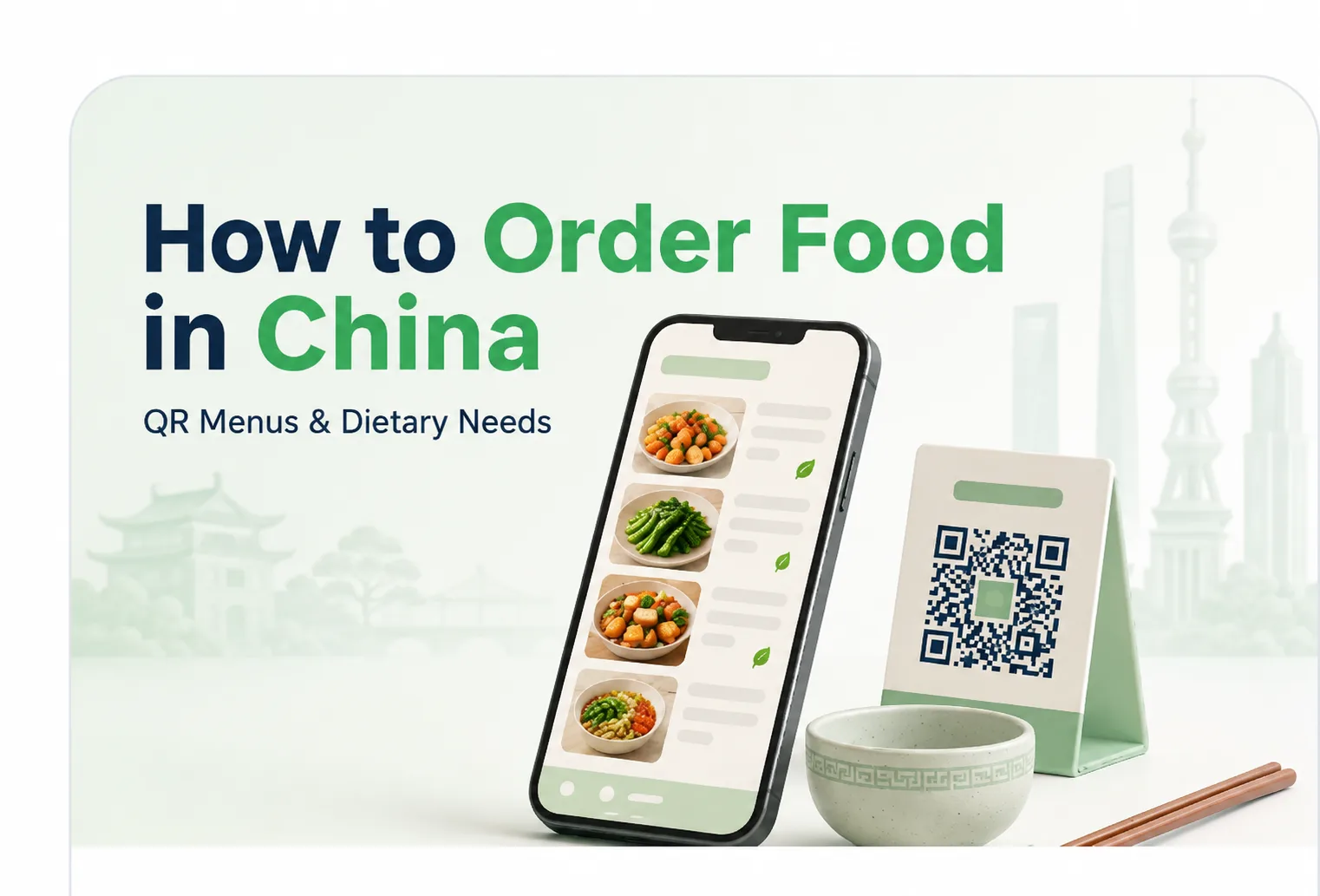
You sit down at a restaurant in China, but no one brings you a menu. Instead, there’s a small QR code attached to the table.
You scan it and a Chinese page opens inside WeChat. The dishes have photos, but the names, options, and buttons are all in Chinese. You’re not sure whether you’ve actually placed the order, and if you’re vegetarian, vegan, or allergic to an ingredient, the pictures don’t tell you enough.
This is now a common way to order food in China. Many restaurants use table-specific QR code menus, although paper menus and staff-assisted ordering are still available in plenty of places.
The main thing is to separate three different actions:
- Scanning the table code to open the menu
- Submitting your food order
- Paying for the meal
They may all happen on the same page, but they may also be completely separate.
Here’s how to order food at restaurants in China, what the Chinese buttons mean, and how to explain dietary restrictions clearly.
What Happens When You Scan a Restaurant QR Code?
The QR code is usually attached to the table, a table sign, a tissue box, or the corner of a printed menu.
It may open:
- A WeChat Mini Program
- An Alipay Mini Program
- The restaurant’s mobile ordering page
- A digital menu that only displays dishes
- A page that lets you order and pay
- A page that lets you order but requires payment at the cashier
The code may already contain your table number. That is why you should scan the code on your own table rather than using one from a nearby table.
Once the menu opens, you normally:
- Choose a food category.
- Tap a dish.
- Select the portion, flavor, or spice level.
- Add it to the cart.
- Check your table number.
- Submit the order.
- Pay immediately or wait until the end of the meal.
A successful payment does not always mean the kitchen received the order, and submitting an order does not always mean you have already paid. Look for an order confirmation page or ask the staff to check.
Chinese Words You’ll See on QR Code Menus
These are the most useful buttons to recognize:
| Chinese | English |
|---|---|
| 菜单 | Menu |
| 点餐 | Order food |
| 招牌菜 | Signature dishes |
| 热菜 | Hot dishes |
| 凉菜 | Cold dishes |
| 主食 | Rice, noodles and other staples |
| 饮料 | Drinks |
| 选规格 | Choose a size or option |
| 口味 | Flavor |
| 辣度 | Spice level |
| 不辣 | Not spicy |
| 微辣 | Mildly spicy |
| 中辣 | Medium spicy |
| 加入购物车 | Add to cart |
| 购物车 | Cart |
| 备注 | Add a note |
| 提交订单 | Submit order |
| 确认下单 | Confirm order |
| 已下单 | Order submitted |
| 加菜 | Add more dishes |
| 买单 / 结账 | Pay the bill |
| 已支付 | Paid |
Machine translation can help you understand dish names and buttons, but it may not correctly identify every ingredient.
If you expect to rely on your phone, install one of the best translation apps for China and download Simplified Chinese before your trip. Camera translation is useful for printed menus, while screenshot translation can help with QR code menus already open on your phone.
What If the QR Code Menu Doesn’t Work?
A QR code menu may fail because:
- It only opens correctly inside WeChat or Alipay.
- It asks you to authorize a Chinese mobile phone number.
- The Mini Program does not work with your account.
- The restaurant’s Wi-Fi or your mobile connection is weak.
- The page requires information you cannot provide.
- The QR code is damaged.
- The page loads, but payment through your foreign card fails.
You do not need to sit there repeatedly scanning the same code. Call a staff member and show one of these sentences.
The QR Code Doesn’t Open
这个二维码打不开。
Zhège èrwéimǎ dǎ bù kāi.
This QR code won’t open.
I Don’t Have a Chinese Phone Number
我没有中国手机号,可以帮我点餐吗?
Wǒ méiyǒu Zhōngguó shǒujī hàomǎ, kěyǐ bāng wǒ diǎncān ma?
I don’t have a Chinese phone number. Can you help me order?
Can I Order With a Staff Member?
请问可以人工点餐吗?
Qǐngwèn kěyǐ réngōng diǎncān ma?
Can I order with a staff member?
Do You Have a Paper Menu?
有纸质菜单吗?
Yǒu zhǐzhì càidān ma?
Do you have a paper menu?
Do You Have an English Menu?
有英文菜单吗?
Yǒu Yīngwén càidān ma?
Do you have an English menu?
Many restaurants can take the order manually through their staff system, even if most local customers order by QR code. A smaller restaurant may simply ask you to point at photos, dishes on another table, or items on a wall menu.
How to Translate a Chinese QR Code Menu
If the ordering page has an English-language button, it may appear as:
- English
- EN
- 英文
- 语言
- Language
- A globe icon
Not every restaurant provides an English version, and automatic English dish names can be unclear. A translation such as “fish-flavored eggplant” does not mean the dish contains fish, while a dish translated as “vegetables” may still contain minced pork or meat stock.
If the menu is open on the same phone you need for translation, take screenshots and import them into your translation app.
You can also:
- Use another person’s phone for camera translation.
- Ask the staff to recommend a dish.
- Show a saved dietary requirement card.
- Point to a dish and ask what it contains.
- Search the Chinese dish name separately before ordering.
Photos help you understand what a dish looks like, but they are not reliable for identifying stock, sauces, cooking oil, or small amounts of meat.
How to Order Vegetarian Food in China
The simplest phrase is:
我吃素。
Wǒ chī sù.
I am vegetarian.
This is useful, but it may not explain your exact diet.
“Vegetarian” can mean different things to different people. Some restaurant staff may assume eggs and dairy are acceptable. Others may remove visible meat but still use meat stock, lard, oyster sauce, or small pieces of minced pork.
If those ingredients matter to you, say so separately.
I Don’t Eat Meat
我不吃肉。
Wǒ bù chī ròu.
I don’t eat meat.
I Don’t Eat Meat or Seafood
我不吃肉,也不吃海鲜。
Wǒ bù chī ròu, yě bù chī hǎixiān.
I don’t eat meat or seafood.
Are There Any Vegetarian Dishes?
请问有素菜吗?
Qǐngwèn yǒu sùcài ma?
Do you have any vegetarian dishes?
Can You Recommend a Vegetarian Dish?
可以推荐几个素菜吗?
Kěyǐ tuījiàn jǐ ge sùcài ma?
Can you recommend some vegetarian dishes?
Do not rely only on the menu category 素菜. In some restaurants, this may simply refer to vegetable-based dishes rather than food prepared under a strict vegetarian standard.
Ask about the ingredients before ordering.
How to Explain That You’re Vegan
Use:
我吃纯素。
Wǒ chī chún sù.
I am vegan.
To make the requirement clearer, show the full sentence:
我吃纯素,不吃肉、海鲜、鸡蛋和奶制品。
Wǒ chī chún sù, bù chī ròu, hǎixiān, jīdàn hé nǎizhìpǐn.
I am vegan. I don’t eat meat, seafood, eggs, or dairy products.
You should also confirm cooking ingredients that may not be visible:
这道菜里有肉、肉汤、猪油或者蚝油吗?
Zhè dào cài lǐ yǒu ròu, ròutāng, zhūyóu huòzhě háoyóu ma?
Does this dish contain meat, meat stock, lard, or oyster sauce?
A vegetable noodle soup may use a meat-based broth. Stir-fried vegetables may contain lard, oyster sauce, or minced meat. Removing the visible meat after cooking does not make the dish vegan.
If you need strict vegan preparation, a dedicated vegetarian or vegan restaurant is usually easier than modifying a dish in a busy local restaurant.
How to Explain a Food Allergy
A food preference and a serious allergy should not be communicated in the same way.
For an allergy, use the word:
过敏
Guòmǐn
Allergic
For example:
Peanut Allergy
我对花生严重过敏,不能吃花生。
Wǒ duì huāshēng yánzhòng guòmǐn, bùnéng chī huāshēng.
I have a serious peanut allergy. I cannot eat peanuts.
Seafood Allergy
我对海鲜过敏。
Wǒ duì hǎixiān guòmǐn.
I am allergic to seafood.
Egg Allergy
我对鸡蛋过敏。
Wǒ duì jīdàn guòmǐn.
I am allergic to eggs.
Dairy Allergy
我对乳制品过敏。
Wǒ duì rǔzhìpǐn guòmǐn.
I am allergic to dairy products.
Please Confirm That This Dish Does Not Contain It
请帮我确认这道菜里没有这个。
Qǐng bāng wǒ quèrèn zhè dào cài lǐ méiyǒu zhège.
Please help me confirm that this dish does not contain this.
For a severe allergy, carry a written Chinese allergy card listing the exact ingredient and the risk of cross-contact.
Do not rely entirely on camera translation or a note entered into the QR code menu. Speak to a staff member and ask them to confirm with the kitchen.
If the restaurant cannot clearly understand or guarantee the requirement, choose another place. Busy kitchens may share cooking oil, woks, utensils, grills, and preparation surfaces.
What About Halal Food?
Look for the Chinese word:
清真
Qīngzhēn
Halal
A restaurant displaying 清真 is a better option than asking an ordinary restaurant simply to remove pork.
You can ask:
这是清真餐厅吗?
Zhè shì qīngzhēn cāntīng ma?
Is this a halal restaurant?
Or:
这道菜是清真的吗?
Zhè dào cài shì qīngzhēn de ma?
Is this dish halal?
Saying that you do not eat pork does not confirm that the meat, stock, cooking oil, or kitchen preparation meets halal requirements. If you follow a strict halal diet, choose a restaurant clearly identified as halal.
How to Choose Spice Level and Remove Ingredients
Chinese QR menus often ask you to choose a spice level before adding the dish to your cart.
Common options include:
| Chinese | English |
| 不辣 | Not spicy |
| 微辣 | Mildly spicy |
| 中辣 | Medium spicy |
| 辣 | Spicy |
| 特辣 | Extra spicy |
If you cannot eat spicy food, use:
不要辣。
Bú yào là.
Not spicy, please.
Other useful requests include:
不要香菜。
Bú yào xiāngcài.
No cilantro.
不要葱。
Bú yào cōng.
No spring onion.
不要花生。
Bú yào huāshēng.
No peanuts.
You can enter these requests in the 备注 field, but speak to the staff if the ingredient relates to an allergy.
Also remember that some dishes cannot be made non-spicy or vegetarian because the sauce, stock, or seasoning has already been prepared.
How Do You Know the Order Went Through?
After submitting the order, look for:
下单成功— Order successful已下单— Order submitted已支付— Paid- An order number
- A list of ordered dishes
- A preparation status
- A payment confirmation
If you are unsure, show the screen to a staff member and ask:
请问已经下单了吗?
Qǐngwèn yǐjīng xiàdān le ma?
Has the order been submitted?
This is worth checking before submitting it again. Otherwise, you may accidentally order the same dishes twice.
If several people at the table scan the same code, do not assume all items automatically enter one shared cart. Restaurant systems work differently. Check the final order list before confirming.
Do You Pay Before or After Eating?
Both systems are common.
Some restaurants require payment when you submit the QR code order. Others send the order to the kitchen first and let you pay after eating. A staff member may also bring a printed bill or direct you to the cashier.
To ask for the bill, say:
买单,谢谢。
Mǎidān, xièxie.
The bill, please.
Or:
请问在哪里结账?
Qǐngwèn zài nǎlǐ jiézhàng?
Where do I pay?
You may be able to pay using:
- Alipay
- WeChat Pay
- Cash in Chinese yuan
- A bank card accepted by the restaurant
- A supported international e-wallet
Alipay and WeChat Pay allow eligible foreign visitors to link supported international cards. Our guide to paying in China with Alipay and WeChat Pay explains how to set them up and what to do if a restaurant payment fails.
A QR code used to open the menu is not necessarily the code used for payment. Do not scan random codes around the cashier until the staff confirms which one you should use.
Restaurant Charges That May Appear on the Bill
The final bill may include small items you did not actively select.
Common examples include:
- Tea
- Bottled water
- Packaged wet wipes or tissues
- Individually wrapped tableware
- A private room charge
- A service charge at some high-end restaurants
If packaged tableware or wet wipes are placed on the table, opening them may add the charge automatically.
Ask before using them if you are unsure:
这个收费吗?
Zhège shōufèi ma?
Is there a charge for this?
Not every restaurant charges for these items, and the amount varies. Check the itemized bill if the total is higher than expected.
Basic Restaurant Etiquette in China
You do not need to memorize a long list of rules. A few habits will make the meal easier.
Dishes Are Often Shared
At many Chinese restaurants, the group orders several dishes for the table rather than one main course per person.
Rice, noodles, soup, or individual set meals may be ordered separately. If you’re dining alone, check the portion size before ordering several full dishes.
Use the Serving Chopsticks When Provided
Some restaurants provide a separate pair of serving chopsticks, often in a different color. Use those to move food from a shared dish to your own bowl.
Don’t Stand Chopsticks Upright in Rice
Place your chopsticks on the holder or across your bowl. Sticking them upright into rice is best avoided.
Rotate the Lazy Susan Gently
If the table has a rotating center, check that no one is serving themselves before turning it.
Tell People About Allergies Before Ordering
Do not wait until the food arrives. Explain serious dietary restrictions before the order goes to the kitchen.
You Normally Don’t Need to Tip
Tipping is not expected at ordinary restaurants in mainland China. Pay the amount shown on the bill unless a clearly listed service charge applies.
Our guide to whether you need to tip in China explains the limited situations where a tip may be more familiar.
What If You Still Can’t Order?
If the QR code fails and the staff cannot help in English, use this order:
- Show the Chinese sentence asking for staff-assisted ordering.
- Ask for a paper or English menu.
- Use screenshots and a translation app.
- Point to photos while confirming dietary restrictions separately.
- Ask the staff to recommend a suitable dish.
- Choose a restaurant with a clearer ordering system if an allergy cannot be understood safely.
If you would rather eat at your hotel or accommodation, you can also order food delivery in China with Meituan and Ele.me, although delivery apps create a different set of challenges involving Chinese addresses, local phone calls, and rider communication.
FAQ
Do I need WeChat to order food at restaurants in China?
Can I ask for a paper menu in China?
Are QR code menus available in English?
How do I say I am vegetarian in Chinese?
How do I say I am vegan in Chinese?
Can a vegetable dish contain meat in China?
Can I pay cash at a restaurant in China?
Do you tip at restaurants in China?
QR code menus can feel confusing the first time, but the process becomes much easier once you recognize the main buttons
Scan the code on your own table, check the table number, add the dishes, confirm that the order has been submitted, and then find out whether payment is required immediately or after the meal.
For dietary restrictions, do not rely only on a translated menu or the phrase “no meat.” Show the exact Chinese ingredients you cannot eat and ask the staff to confirm with the kitchen before placing the order.
More to read
How to Use Public Transport in China: Metro, Buses & QR Codes for Tourists (2026)
2026.08.31
QR Code Payment in China: How to Scan and Pay as a Foreigner (2026)
2026.08.31