How to Take High-Speed Trains in China: A Guide for Foreign Travelers
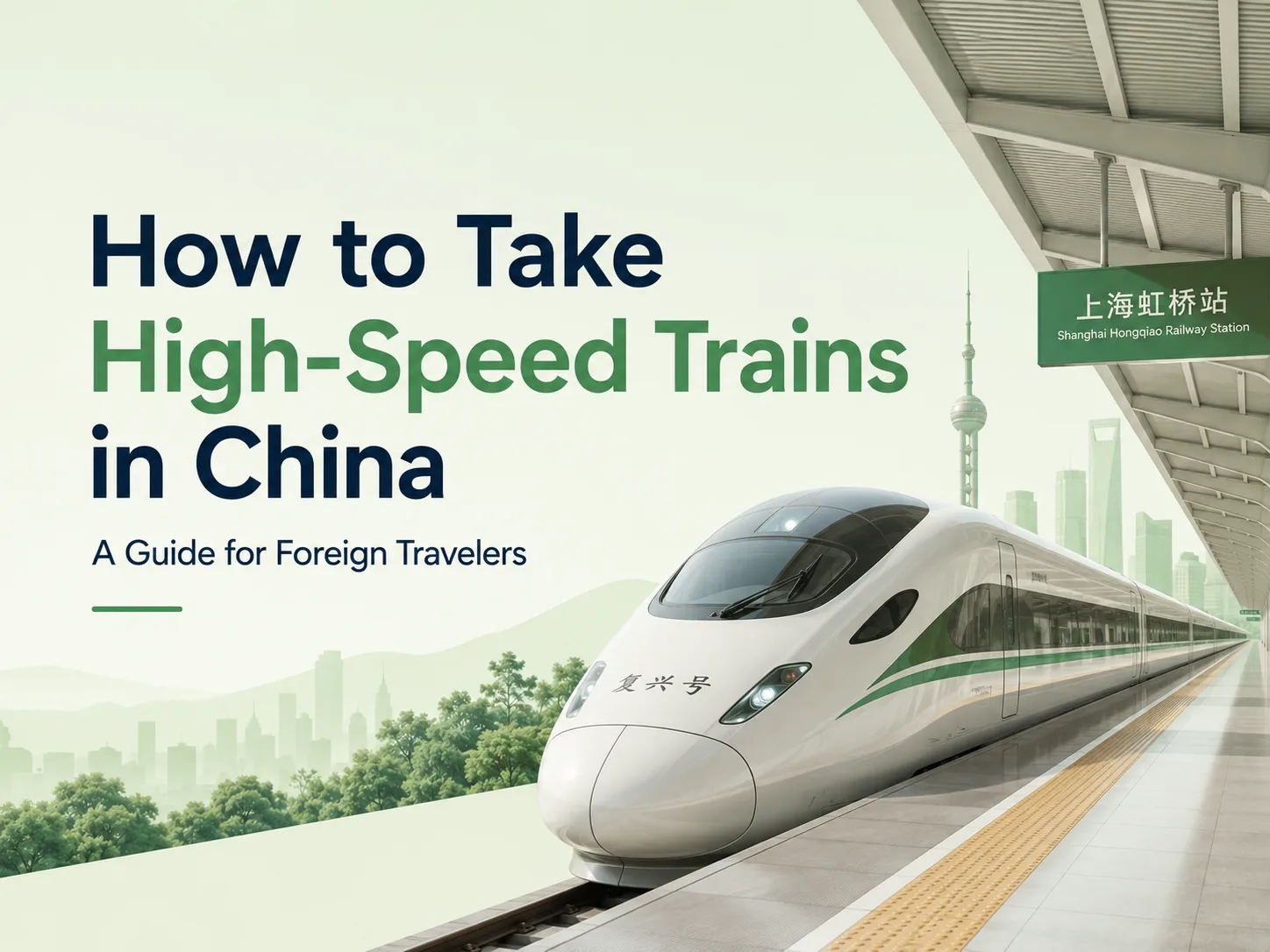
Taking a high-speed train is one of the easiest ways to travel between cities in China.
If you're going from Shanghai to Hangzhou, Beijing to Shanghai, Guangzhou to Shenzhen, or traveling between many other Chinese cities, high-speed rail is often fast, comfortable, and easy to use once you know how it works.
But if it's your first trip to China, you probably have a few questions.
Can foreigners buy train tickets in China? Do you need a Chinese ID card? Can you use your passport? Where should you buy tickets? And what exactly happens when you arrive at the railway station?
The good news is that foreign travelers can use China's high-speed rail system with a valid passport.
Here's what you need to know.
1. Can Foreigners Take High-Speed Trains in China?
Yes.
Foreign tourists can travel on China's high-speed rail network using a valid passport.
You don't need a Chinese ID card.
China Railway accepts valid foreign passports for real-name train ticket purchases. Your booking is linked to the identification document you use when buying the ticket.
That means one thing is especially important:
Bring the original passport you used to book your ticket.
You'll need it during your journey.
2. Where Can Foreigners Buy China Train Tickets?
There are several ways to buy train tickets in China.
For most international visitors, the main options are:
- China Railway 12306
- Railway station ticket counters
- Third-party travel booking platforms
China Railway 12306
China Railway 12306 English Website is the official railway ticketing platform.
Foreign travelers can use the English-language service to search for trains, purchase tickets, and handle eligible ticket changes and refunds.
If you're going to take more than one train during your trip, it's worth getting familiar with 12306.
Buying Tickets at the Railway Station
You can also buy train tickets at a railway station ticket counter.
Bring your original passport.
This works perfectly well, but I wouldn't leave it until the last minute for a popular route. The train or seat class you want may already be sold out.
3. How to Register for 12306 as a Foreigner
Foreign travelers can register for 12306 using a valid foreign passport.
You'll need to enter personal information such as your:
- Name
- Passport number
- Passport expiration date
- Date of birth
- Nationality
- Email address
Enter Your Name Carefully
Take your time with this part.
Enter your personal information according to your passport and follow the format requested by 12306.
Don't use a nickname or casually shorten your name.
Your train booking is connected to your passport identity, so getting these details right from the beginning can save trouble later.
4. Do Foreigners Need Identity Verification on 12306?
Yes.
Foreign travelers need to complete identity verification before purchasing tickets through 12306.
Depending on the verification process shown to you, you may be asked to enter your passport information and upload an image of your passport information page.
Identity verification can also be handled at a railway station ticket office when necessary.
Gochinio Tip: Set up and verify your 12306 account before the day you actually need to buy an important ticket. It's much nicer to sort this out at home than while you're trying to catch a train.
5. How to Buy a High-Speed Train Ticket in China
Once your account is ready, buying a ticket is fairly straightforward.
Step 1: Choose Your Departure Station
Enter the city or railway station you're leaving from.
Step 2: Choose Your Destination
Enter the city or station you're traveling to.
Step 3: Select Your Travel Date
Choose the date you want to travel.
Step 4: Choose a Train
For high-speed rail, you'll commonly see train numbers beginning with:
G — High-speed trains
D — EMU trains
You don't need to memorize China's entire train classification system.
What matters more is:
Departure station → Arrival station → Departure time → Journey time → Seat class
And there's one detail here that's much more important than it may seem.
6. Check the Station, Not Just the City
This is probably one of the most useful things to know before taking your first train in China.
Many large Chinese cities have more than one railway station.
For example, Beijing has:
- Beijing Railway Station
- Beijing South Railway Station
- Beijing West Railway Station
- Beijing North Railway Station
Shanghai also has several major stations.
So don't just see:
Beijing → Shanghai
and assume you know where to go.
Look carefully at the full station name on your booking.
Two railway stations in the same city can be a long way apart.
Gochinio Tip: Before leaving your hotel, save the railway station's Chinese name on your phone.
For example:
Shanghai Hongqiao Railway Station — 上海虹桥站
If you're taking DiDi to the station, use the exact station shown on your ticket.
You can also read our How to Use DiDi in China: A Guide for Foreign Travelers before your trip.
7. Which Seat Class Should You Choose?
On many Chinese high-speed trains, you'll see several seat classes.
Second Class
This is what most travelers choose.
It's comfortable for most journeys and usually offers the best balance between price and comfort.
First Class
First Class gives you more space and wider seats and can be nice for longer journeys.
Business Class
This is the premium option.
The seats are much more spacious, but the price is also considerably higher.
Not every train offers every seat class.
For most foreign tourists visiting China:
Second Class is perfectly fine.
There's no need to book Business Class simply because you're traveling with luggage or don't speak Chinese.
8. Can Foreigners Pay for China Train Tickets with International Cards?
Yes, eligible international bank cards can be used through supported official purchasing channels.
Depending on how you buy your ticket, payment options may include:
- International bank cards
- Chinese bank cards
- Alipay
- Weixin Pay / WeChat Pay
- RMB cash at supported station counters
If you've already set up mobile payments for your trip, buying tickets and getting around China becomes much easier.
See our How to Pay in China: Alipay, WeChat Pay & Cash Guide for Foreigners if you haven't done that yet.
9. Do You Need to Print Your Train Ticket?
For normal domestic e-ticket journeys, generally no.
China Railway uses electronic tickets.
Your booking is connected to the identification document used when purchasing the ticket.
For most foreign tourists, that means your:
Original passport
is the important thing to carry.
Keep your train number, departure time, carriage number and seat number on your phone so they're easy to check.
China Railway can also provide an itinerary information sheet, but this is not the same thing as a paper ticket used for boarding.
10. What Should You Bring to the Railway Station?
For a typical high-speed train journey, you don't need much:
- Original passport
- Booking information
- Phone
- Luggage
- A working internet connection
The most important one is your passport.
Don't leave it at the hotel.
Keeping a photo of your passport on your phone is a sensible backup while traveling, but don't assume a photo replaces the original passport for railway identity checks.
11. How Early Should You Arrive?
Chinese high-speed trains generally run on tight schedules, and some railway stations are enormous.
Before boarding, you may need to:
Enter the station → Verify your identity → Pass security → Find your waiting area → Find your gate → Board
At a smaller station, this may be quick.
At a huge station such as Shanghai Hongqiao, Beijing South or Guangzhou South, simply walking to the correct area can take some time.
For your first high-speed train trip in China, arriving around 45–60 minutes before departure gives you a comfortable buffer.
This isn't a universal railway requirement. It's simply a practical recommendation for someone navigating an unfamiliar Chinese station for the first time.
Once you're familiar with the station, you'll have a much better idea of how much time you actually need.
12. How Do You Enter the Station with a Foreign Passport?
When you arrive, follow the signs for station entry and ticket or identity checks.
Have your passport ready.
Depending on the station and available equipment, you may be able to use an automatic gate or you may need to use a manual inspection lane.
If your foreign passport doesn't work at an automatic gate:
Don't worry.
Look for railway staff or a manual inspection channel and show your passport.
It doesn't automatically mean there's anything wrong with your ticket.
13. Do You Have to Go Through Security?
Yes.
Passengers normally pass through a security check before entering the main departure area.
Your bags will usually be screened.
China Railway has rules covering prohibited and restricted items, so if you're carrying unusual liquids, sprays, tools, batteries or other potentially restricted items, check the current railway rules before traveling.
For an ordinary traveler with a suitcase or backpack, the process is usually straightforward.
14. How Do You Find Your Train?
Once you're inside the station, check the departure screens.
Look for your:
- Train number
- Departure time
- Destination
- Boarding gate
- Boarding status
Your train number might look something like:
G1234
or:
D1234
The easiest thing to match is the train number.
Don't rely only on the destination because several trains may be heading toward the same city.
15. How Does Boarding Work?
When boarding begins, passengers line up at the designated gate.
Have your passport ready.
After passing the ticket and identity check, follow the signs to the platform.
Then look for your:
Carriage number → Seat number
For example:
Car 08 / Seat 12A
Find the correct carriage first, then find your seat.
The stations can look intimidating when you first walk in, but the actual boarding process is quite systematic.
Once you've done it once, the whole thing makes much more sense.
16. What About Luggage on High-Speed Trains?
For most normal luggage, you keep your bags with you rather than checking them in like you would on a flight.
Smaller bags can usually go on overhead luggage racks.
Larger suitcases may need to go in available luggage storage areas, depending on the train and carriage.
If you're traveling with a large suitcase, don't wait until the last second to board.
Give yourself time to find somewhere suitable to put it.
Keep your passport, wallet, phone and other valuables with you.
17. What If You Miss Your Train?
Don't immediately assume that your ticket is useless.
China Railway allows eligible tickets to be changed under certain conditions, depending on the timing and seat availability.
If you miss your train, check 12306 or speak to railway staff as soon as possible.
The options available will depend on your ticket and the current railway rules.
18. Can You Change or Refund a China Train Ticket?
Yes, eligible tickets can be changed or refunded under China Railway's current rules.
The 12306 platform provides ticket change and refund services.
The exact conditions and possible fees depend on factors such as how close you are to departure.
Because these rules can change, check the conditions shown by 12306 when you actually need to change or cancel a ticket rather than relying on an old fee table from a travel website.
19. High-Speed Train or Plane: Which Is Better?
It depends on where you're going.
For shorter and medium-distance journeys, high-speed rail can be incredibly convenient.
Routes such as:
Shanghai ↔ Hangzhou
Guangzhou ↔ Shenzhen
Beijing ↔ Tianjin
are obvious examples where high-speed rail makes a lot of sense.
Railway stations are also often better connected to urban areas than airports.
For much longer journeys, flying may still save time.
The best approach is simply to compare:
Total train journey time vs. total flight journey time
Don't look only at the time spent in the air. Getting to the airport, arriving early and traveling from the destination airport into the city all count too.
20. A Few Tips for Your First High-Speed Train in China
If this is your first time using China's railway system, remember these:
Check the station, not just the city.
This is probably the most important tip in this guide.
Bring your original passport.
Your booking is connected to it.
Arrive early the first time.
Give yourself time to understand the station.
Save your train number.
It's the easiest way to find your train on the departure screens.
Keep the station name in Chinese.
Very useful when using DiDi or asking someone for directions.
Don't wait until the station to buy a popular train.
Popular trains can sell out.
Keep your phone charged.
You'll probably use it for tickets, maps, payments and transportation throughout the day.
Your First High-Speed Train Is Easier Than It Looks
Chinese railway stations can look enormous the first time you walk into one.
But the actual process is pretty simple:
Book your ticket → Bring your passport → Enter the station → Security → Find your gate → Board
And if there's one thing worth remembering from this guide, it's this:
Check which railway station you're leaving from.
Get that right, arrive with enough time, and keep your passport handy.
After your first journey, taking high-speed trains around China will feel much easier.
And for many trips, it's one of the best ways to explore the country.
Official Sources & Information Note
This guide is based on information published by China Railway 12306 and current Chinese government guidance for international visitors.
Railway ticketing procedures, identity verification, payment methods, refund rules, station facilities and other requirements can change.
Before traveling, check your booking information and the latest railway guidance.
FAQ
Can foreigners take high-speed trains in China?
Can foreigners use 12306?
Do I need a Chinese ID card to buy a train ticket?
Do I need to print my China train ticket?
Can I buy China train tickets with a foreign credit card?
Can I buy a train ticket at the station?
Should I choose First Class or Second Class?
What if my passport doesn't work at the automatic gate?
How early should I arrive for a high-speed train?
More to read
How to Use Public Transport in China: Metro, Buses & QR Codes for Tourists (2026)
2026.08.31
QR Code Payment in China: How to Scan and Pay as a Foreigner (2026)
2026.08.31